Exploring from Lamar
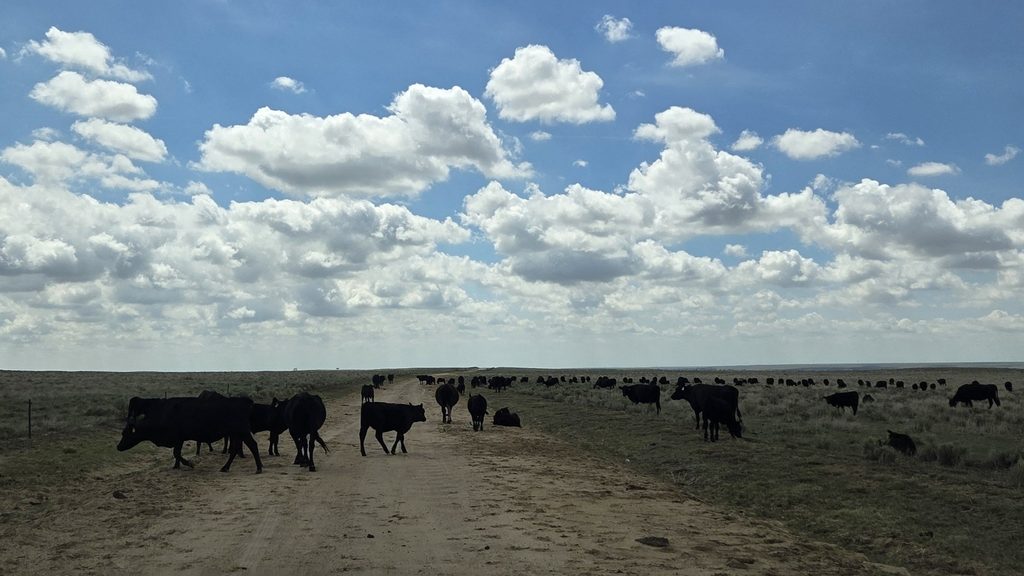
Lamar, at ~7,700 population, is the largest municipality and the county seat of Powers County in the Southeastern corner of Colorado. It is in the Lower Arkansas River Valley, roughly 30 miles west of the Kansas border, and sits at 3,619′ elevation. Lamar is the major industrial, agricultural, and retail hub for the southeastern plains of the state.
Like in western Kansas, we’ve seen lots of sorghum and sunflowers growing around here, and … grazing cattle.
Our first 2 days, we drove north an hour, west an hour, and east 1/2 hour, a total of 240 miles RT, to…
Visit 3 new National Park Sites (and a NHT repeat):
- Sand Creek Massacre National Historic Site (#361), where, in November 1864, Chiefs Black Kettle, White Antelope, Left Hand and others were encamped with around 750 Arapaho and Cheyenne people in a valley by the Big Sandy Creek. Hoping for peace, they were gathered to “surrender” to the US Army. Black Kettle, who had brokered the peace deal, was even flying an American flag and a white flag of truce. Instead of a peaceful surrender, on November 29, 1864, Colonel John Chivington, leading roughly 675 troops of the Colorado Territory Militia and Third Colorado Cavalry, attacked this encampment. They killed and mutilated 230 of the ~750 people, mostly women and children and some chiefs. The warriors were camped elsewhere, so as not to look threatening!
The massacre profoundly influenced US-Indian relations and the structure of the Cheyenne and Arapaho tribes. This has been a painful memory for generations of Native Americans. Captain Silas Soule and Lieutenant Joseph Cramer (who held their own troops back) reported the massacre to their superiors. They also testified, making this the only Native American Massacre actually called a Massacre in the timeframe in which it was committed. In 2000, letters from Captain Silas Soule and Lieutenant Joseph Cramer resurfaced and helped get the site made a protected National Park Site.
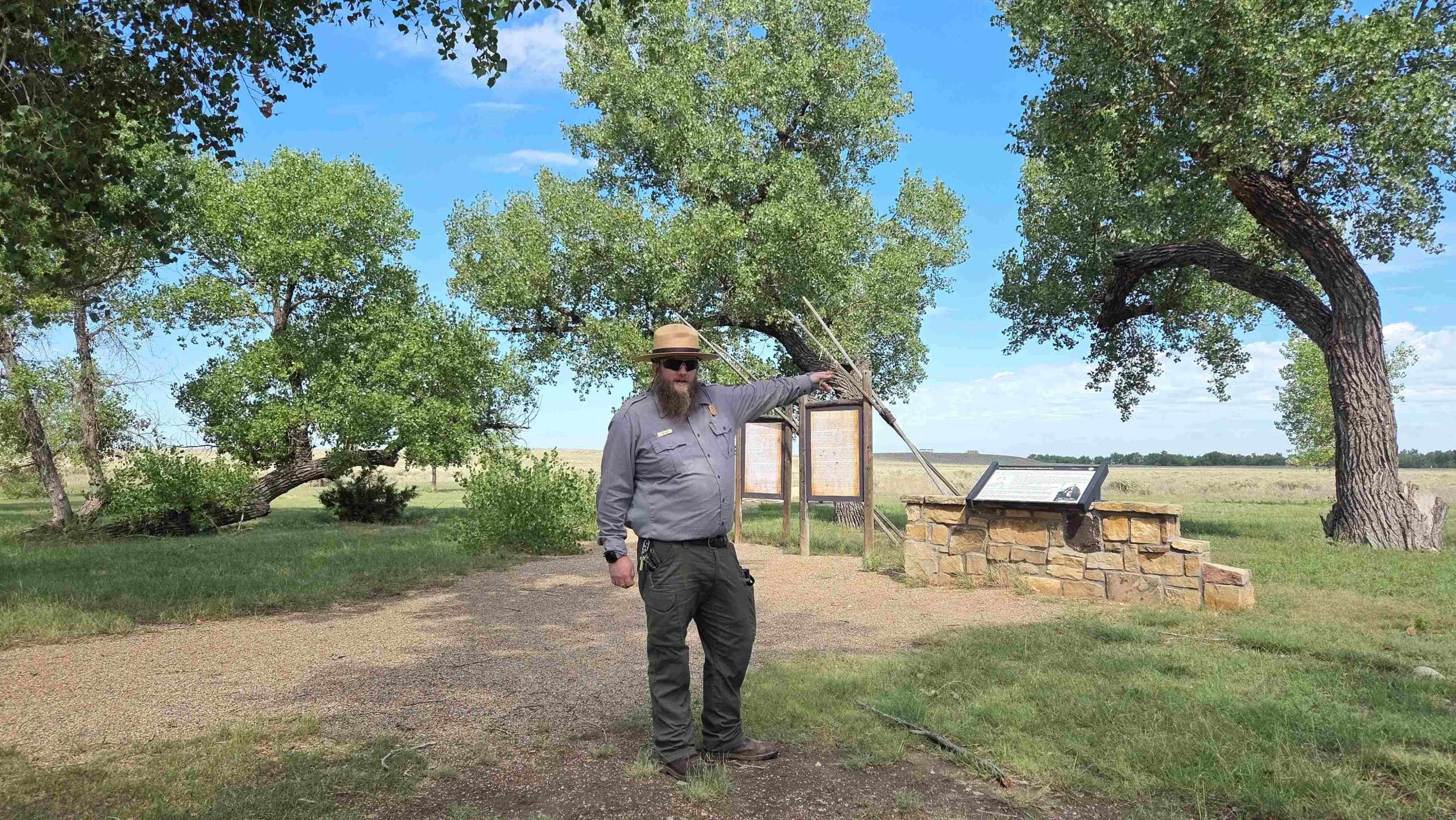
Sand Creek Massacre NHT-Ranger Tim giving an EXCELLENT history talk, pointing toward the Arapaho & Cheyenne encampment. Learning the history of the massacre was the real point of visiting, vs the “scenery” 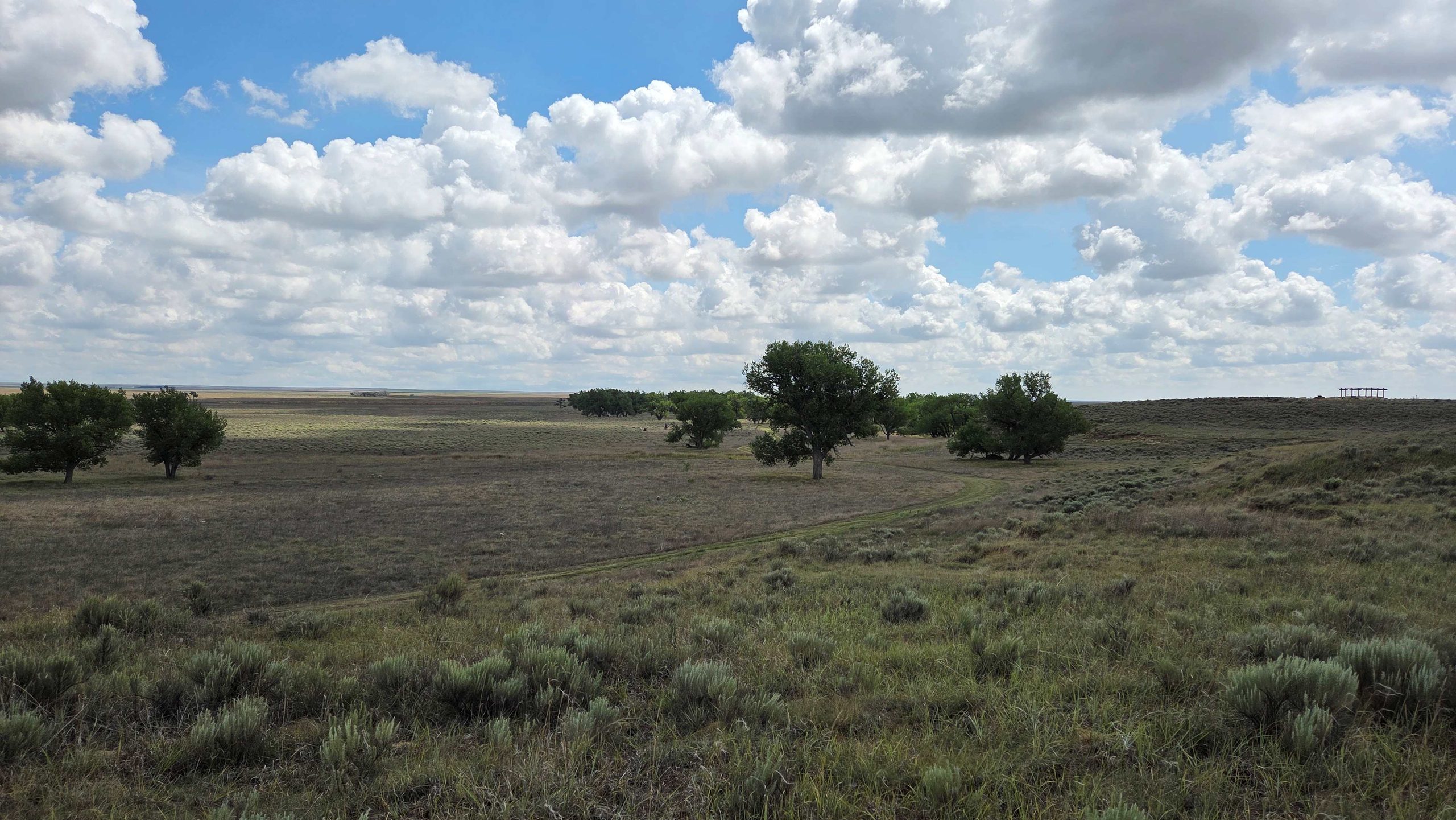
Sand Creek Massacre NHT-we did take a short walk along the bluff above the Arapaho & Cheyenne encampment
- Bent’s Old Fort National Historic Site (#362), where a reconstructed adobe fort allows visitors to explore the front line of Westward Expansion. In the 1840s the Arkansas River was the border between territory claimed by the United States and Mexico. Located along the river, Bent’s Fort was an adobe trading post on the Santa Fe Trail, where traders, trappers, travelers, and the Cheyenne and Arapaho tribes came together in peaceful terms for trade. The site was made a National Historic Site in 1960 and the reconstructed fort was built in 1976.
Unfortunately, the 1976 building contractor didn’t understand that putting cement in adobe does not make it better! So the fort is crumbling and one can now only visit a portion of it on a limited tour. We did get such a tour. If you’re wondering, putting cement in traditional adobe bricks traps moisture inside and creates a rigid material that breaks apart when the mud naturally shrinks and swells. Adobe needs to breathe and bend, but cement makes it stiff and blocks water from escaping. - Santa Fe National Historic Trail revisit, first where it passed right by Bent’s Old Fort (and later, where it passes through John Martin Reservoir State Park and again in Lamar!)
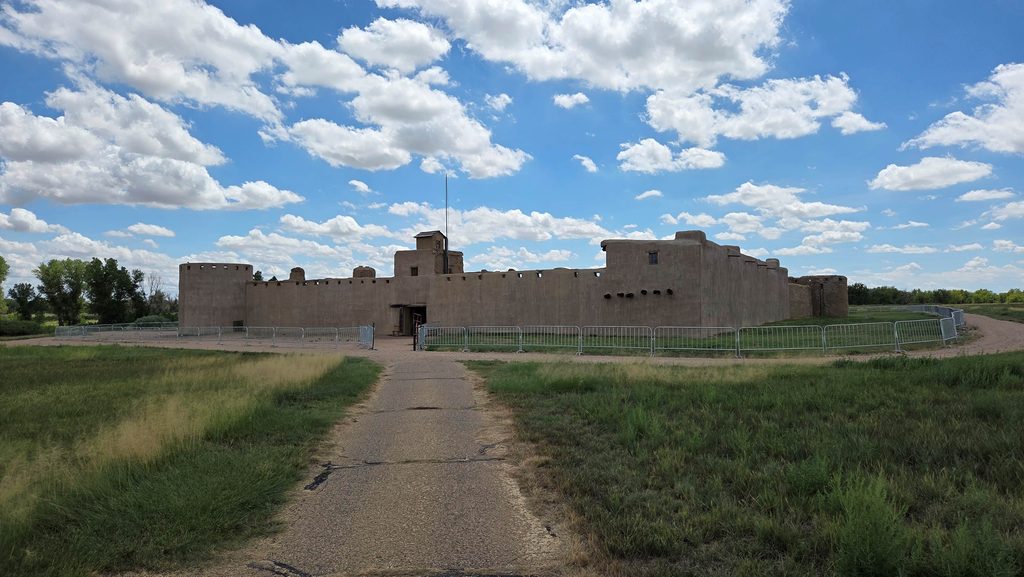
Approaching the reconstructed Bent’s Old Fort structure 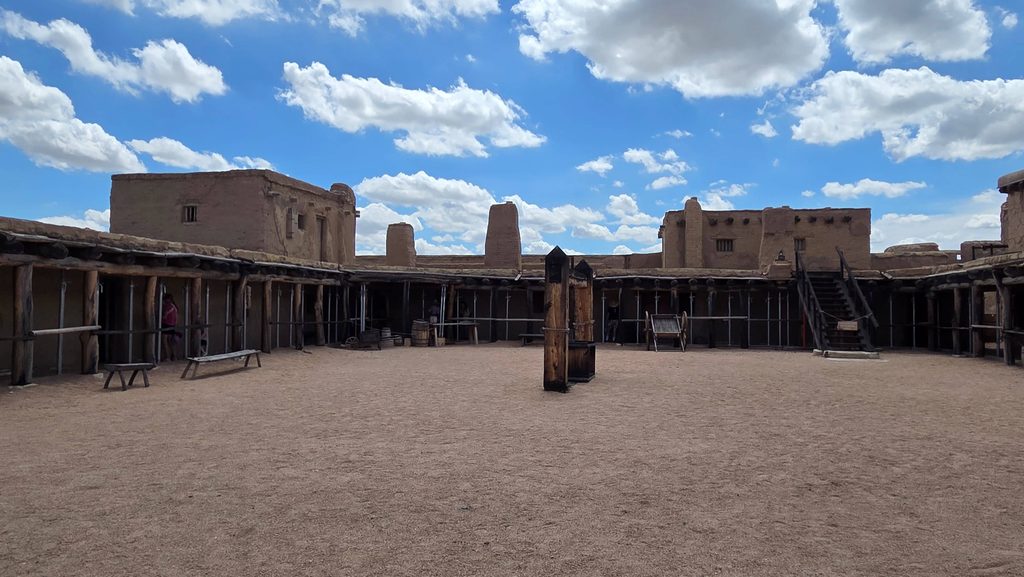
Inside the reconstructed Bent’s Old Fort structure. Notice the metal posts holding the structure up. No, that isn’t a well in the center, it’s a Fur Press! 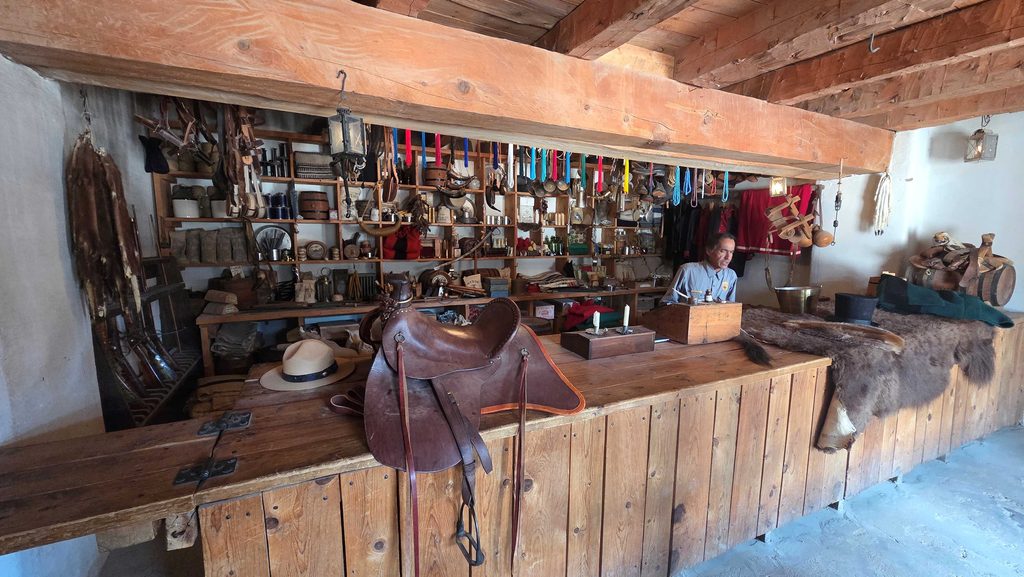
Bent’s Old Fort NHS- Ranger Mario giving us a tour and a history lesson, here in the trading post room at the fort”
- Amache National Historic Site (#363), located in a remote corner of southeastern Colorado, also known as the Granada Relocation Center, was one of ten incarceration sites established by the War Relocation Authority (WRA) during World War II (WWII). It was created to unjustly incarcerate Japanese Americans who were forcibly removed from their communities on the West Coast through Executive Order 9066. From 1942-1945, over 10,000 people of Japanese ancestry, most of them American citizens, passed through Amache. At its peak population in 1943, Amache housed 7,310 people, making it the tenth largest population center in Colorado at the time.
We started at the Amache Museum in downtown Grenada, which serves as the Visitor Center. Excellent exhibits. We learned that the Amache Relocation Center was “the opposite” of Tule Lake (the worst of the 10 sites). At Amache, the incarcerated were generally so trusted, that they could walk into town (~a mile away), and 2 actually opened a store in Granada, while incarcerated! It was also true, however, if someone did “mis-behave”, they might get sent to Tule Lake.
After the museum, we drove to the Amache Relocation Center Site to do the auto tour. The ~1 mile square site currently has many building foundations remaining, as well as the original water tower, a reconstructed Rec Center, Barracks, and Guard Tower, and a cemetery where a few graves remain (most were moved later.)
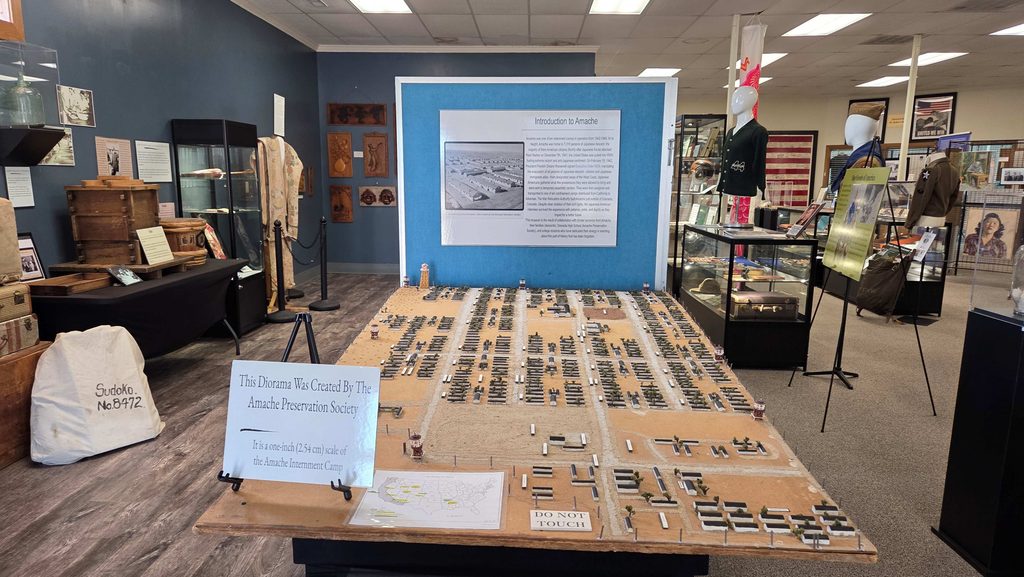
Entering Amache Museum, there is a scale model of the Amache Internment Camp 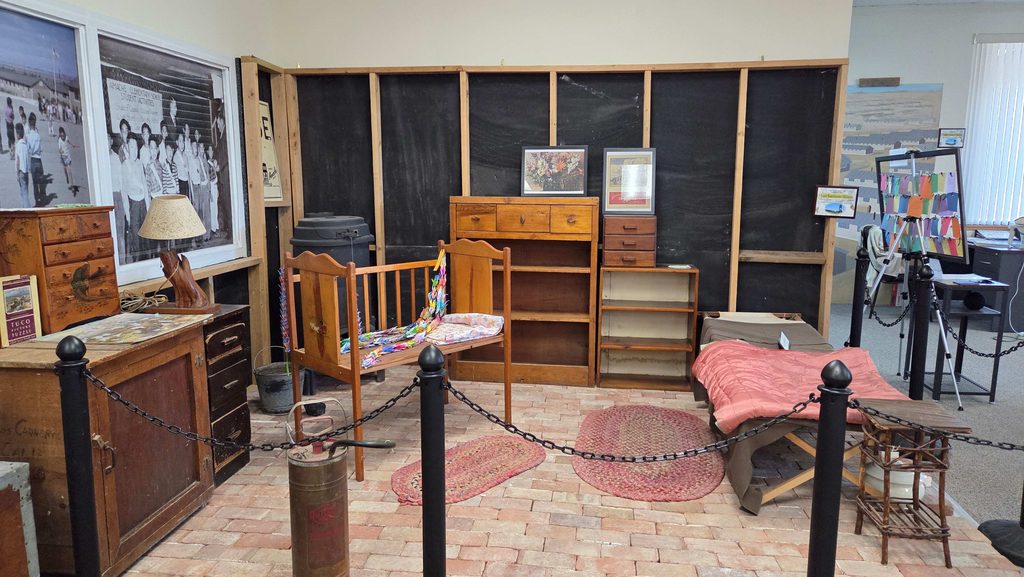
At the Amache Museum, am example of a room in which one family would live at the Amache Internment Camp. Only the cot, blanket and stove were supplied. All other furniture was built by internees at the camp from scrap wood. 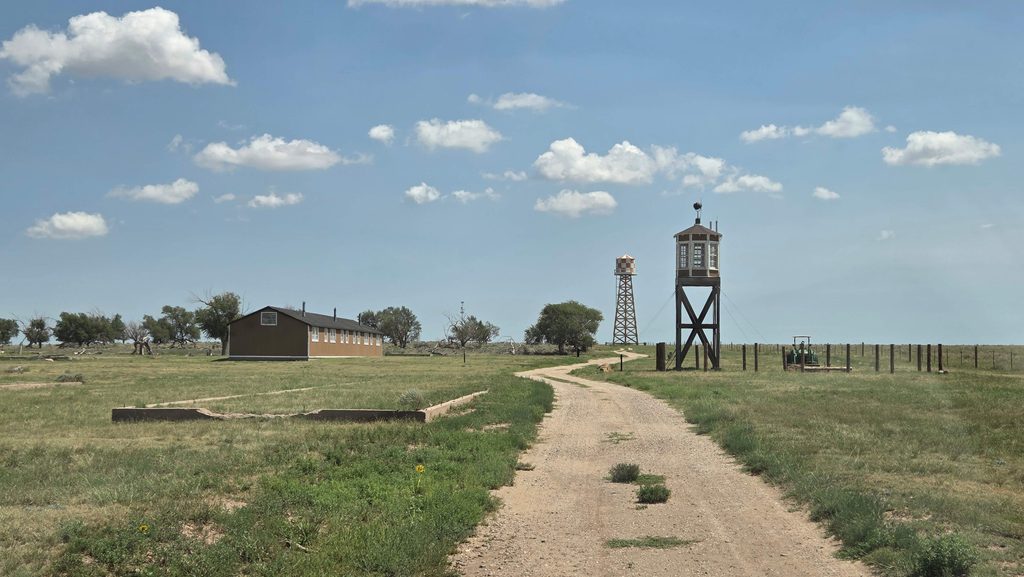
On the Amache NHS auto tour, view of a replica Barracks Building, an original Water Tower, and a replica Guard Tower. 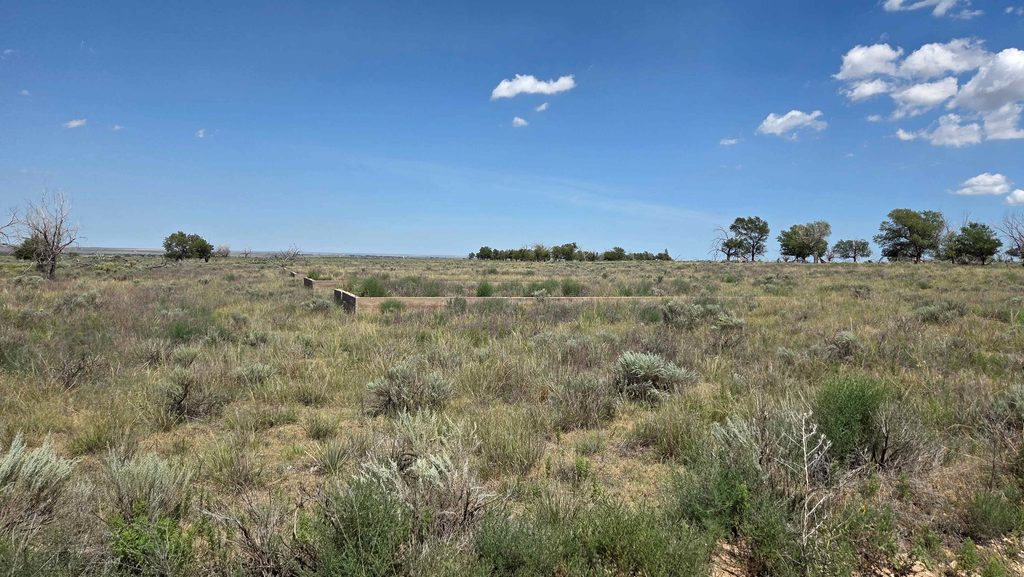
On the Amache NHS auto tour, view of several building foundations
Hanging out in Lamar
We stopped at John Martin Reservoir State Park on our way back from Bent’s Old Fort, to drive over the dam (our 3rd Army Corp of Engeers Dam in ~10 days!) Then we stayed around Lamar the last 2 days, checking out local historical places, catching up on stuff, finally starting to watch World War II with Tom Hanks (which we recorded weeks ago), and Mark even gave The Monster a good washing. She’s killed so many bugs and butterflies lately, time to wash off the bug juice! Oh…it hit 100o again on Tuesday.
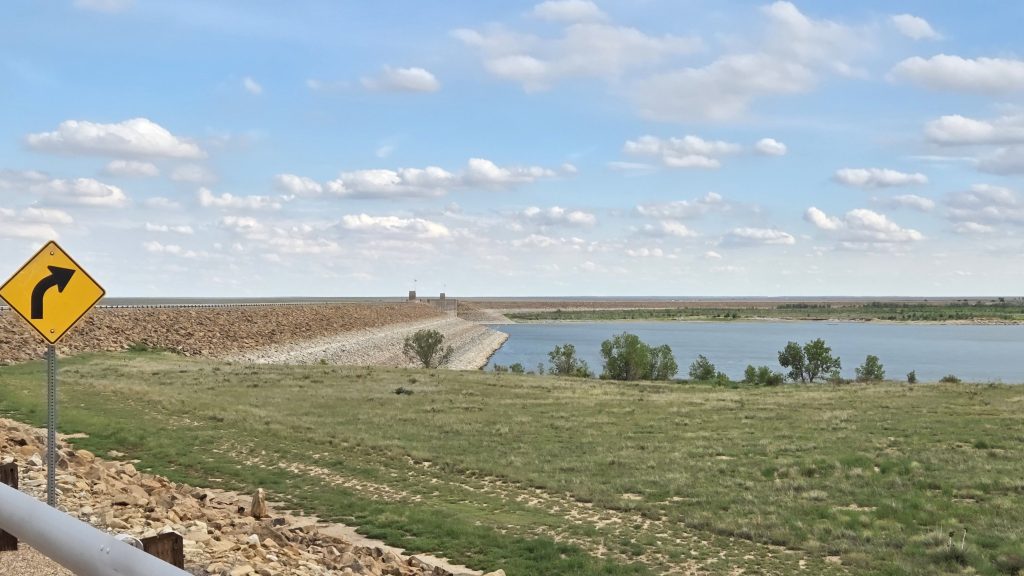
About to drive over the John Martin Reservoir Dam, one can see how LOW the water level is! 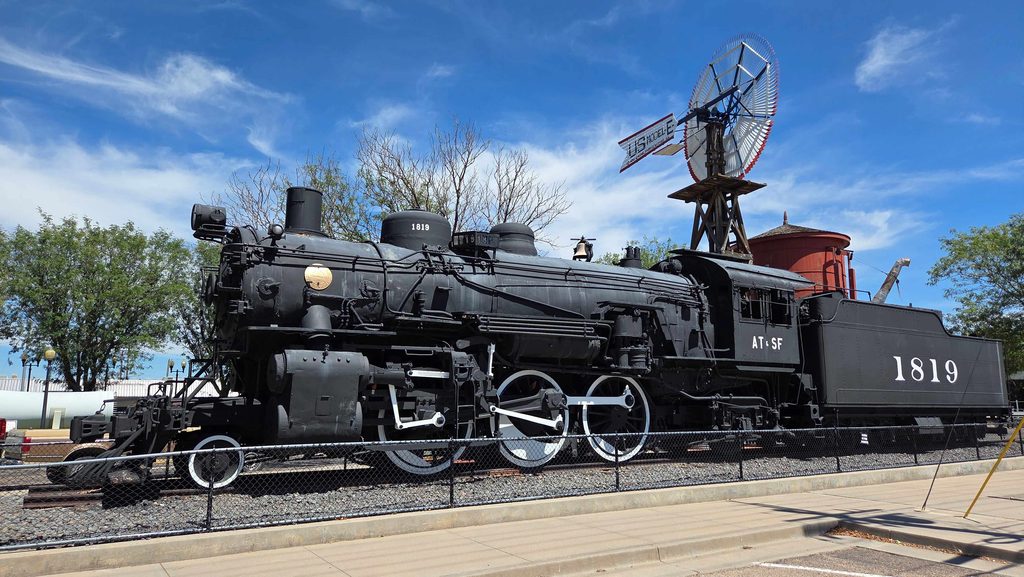
Santa Fe Prairie Engine No 1819 at the Colorado Welcome Center in Lamar 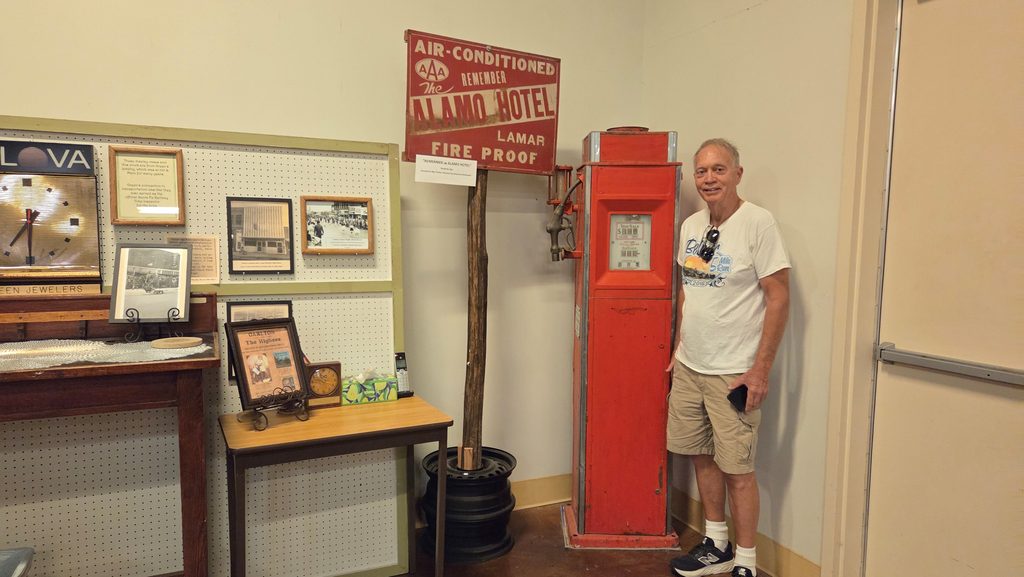
At the Big Timber Museum, obligatory picture of Mark with an old gas pump. Also shown, an ad for the Alamo Hotel, one of only 11 hotels in all of Colorado in the Green Book 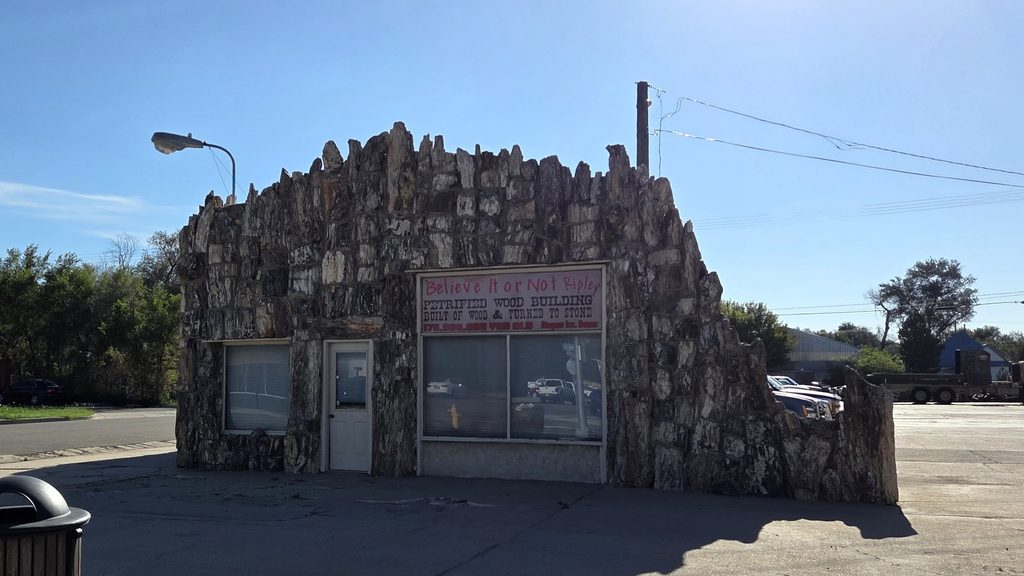
The oldest gas station anywhere, per Ripley’s Believe it or Not …HA, HA, HA… built of petrified wood.
0 Comments